
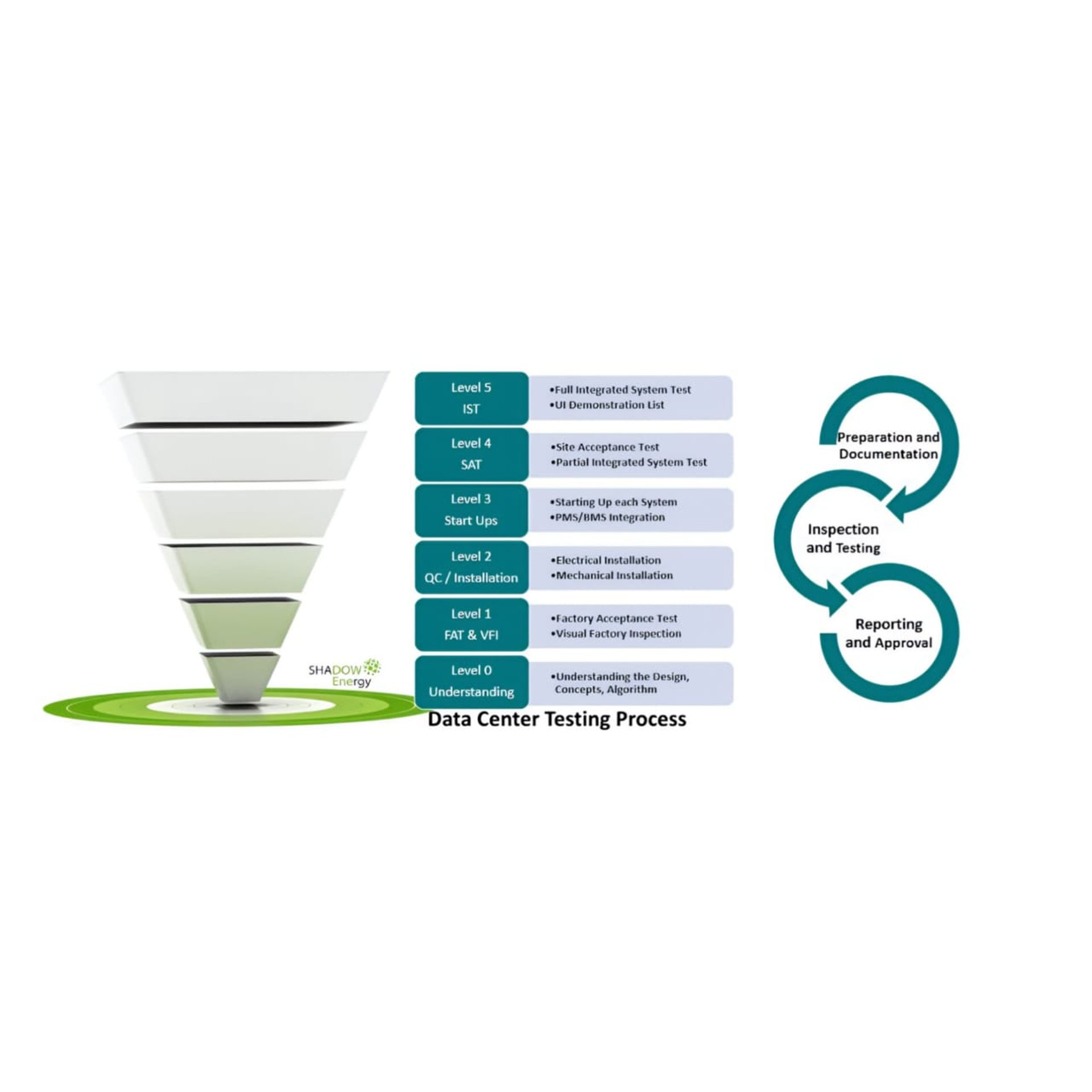
Level 2 Testing – Electrical & Mechanical
During Data Center Due Diligence L2 Testing, we ensure that all electrical and mechanical systems are properly installed, connected, and ready for seamless operation. This stage validates both power distribution and backup infrastructure to avoid downtime risks.
Key Activities in L2 Testing:
Physical Connection Test – Checking all electrical wiring, panels, and cabling for secure and safe installation.
Transformer Connection – Validating transformer setup, wiring integrity, and load management for reliable power supply.
DG (Diesel Generator) Connection – Testing generator installation and connectivity for smooth emergency power backup.
UPS (Uninterruptible Power Supply) Connection – Ensuring UPS systems are connected and functioning to provide uninterrupted support for critical loads.
Switchgear & Panel Testing – Verifying control panels and switchgear for proper electrical operation.
Mechanical Installation Check – Inspecting HVAC, cooling systems, and related mechanical setups for efficiency and compliance.
Safety & Compliance Verification – Ensuring all installations meet data center safety standards and compliance requirements.
Why Level 2 Testing is Important?
Strengthens data center reliability
Prevents electrical and mechanical failures
Assures compliance and safety standards
Provides a strong foundation for advanced system testing
Level 3 Testing – Electrical & Mechanical
L3 Testing in Data Center Due Diligence focuses on advanced electrical and mechanical performance validation. This stage ensures that all critical power and backup systems are tested under different load conditions to guarantee reliability, safety, and compliance.
Key Activities in L3 Testing:
Burn-In Test (Transformer, DG, UPS) – Verifying performance and endurance of transformers, diesel generators, and UPS systems under continuous operation.
Transient Test / Jerk Load Test – Testing system response by applying sudden load variations (0% → 33% → 52% → 70% → 87% → 100%) to ensure stability.
Inrush Current Test – Measuring initial current surge when equipment is energized to prevent failures.
HiPot Test – High potential voltage testing to validate insulation integrity and electrical safety.
Relay Testing – Ensuring protection relays function correctly for fault detection and system safety.
Megger Test – Checking insulation resistance of cables, transformers, and equipment.
Primary Injection Testing – Simulating faults to validate protective device accuracy and circuit breaker operation.
Secondary Injection Testing – Testing relay logic and trip settings without energizing high-voltage systems.
Thermography – Using infrared scanning to detect overheating, hotspots, and potential risks in electrical and mechanical systems.
Why L3 Testing is Important?
Validates power system reliability under real load conditions.
Ensures safety compliance and fault protection.
Detects hidden issues before system integration.
Enhances data center uptime and performance.
Level 4 Testing – Electrical & Mechanical
L4 Testing (Pre-IST / SOO Test) is a critical stage in Data Center Due Diligence where system functionality, performance, and safety are verified before the Integrated System Test (IST). This phase ensures that both electrical and mechanical systems are fully prepared for real-time operations.
Key Activities in L4 Testing:
BMF Verification – Checking Busbar, Metering, and Feeder connections for accuracy, reliability, and compliance with design.
Panel Functional Test – Verifying operation of electrical panels, switchgear, and control circuits for safe and efficient performance.
Load Test (Transformer, DG, UPS) – Applying measured loads on transformers, diesel generators, and UPS systems to validate capacity, backup support, and stability.
Data Temperature Test – Monitoring temperature levels in critical equipment and rooms to ensure proper cooling and thermal efficiency.
Thermography – Using infrared scanning to detect hotspots, overheating risks, and insulation issues in electrical and mechanical components.
Why L4 Testing is Important?
Confirms system readiness before IST.
Ensures panel functionality and load capacity.
Detects thermal and electrical anomalies early.
Strengthens data center reliability, compliance, and uptime.
Level 5 Testing – Electrical & Mechanical
L5 Testing is the final stage of Data Center Due Diligence before full integration, focusing on BMS (Building Management System) verification and ensuring all tests align with design and operational scripts. This phase validates that the electrical and mechanical systems function as intended and meet compliance standards.
Key Activities in L5 Testing:
BMS Verification as per Script – Checking that the Building Management System is integrated, monitored, and controlled according to the pre-defined operational script.
Testing as per Script & Panel Design – Verifying all electrical panels, control circuits, and system functions are tested according to the design documents and approved testing scripts.
Why L5 Testing is Important?
Confirms BMS functionality for monitoring and control.
Ensures all systems operate as per approved design and test scripts.
Provides the final validation before Integrated System Testing (IST).
Strengthens compliance, efficiency, and system reliability.
Data Center
Comprehensive assessments ensure reliability and compliance for data centers.


Risk Assessment
Identify potential risks and verify performance metrics for informed decisions.


Expert Insights
Gain expert insights and technical audits for data center evaluations.
Data Center Testing
Comprehensive assessments ensure reliability, efficiency, and informed decisions.


Contact Us
Reach out for expert insights on data center assessments.
Assess
Comprehensive evaluations for data center reliability.
Get in touch
Audit
© 2025. All rights reserved.
address
Noida - 2nd Floor, B-52, Block Sector 64, Noida, Uttar Pradesh , 201301